
Boszball is as flawed and fun as ever, meet the Russian Premier League quartet spearheading the title race and more — Volume 3, Issue #11
Plus a throwback hat-trick for the FMers.

Scrolling through the relevant football app provider, it felt like the first time this season that there was too much football.
There were games I didn’t know were being contested, players I didn’t know were playing, and leagues I didn’t know were still running. Yet, like we all do, it’s too hard to resist. Just have to dig in and see what’s happening. And as always, there’s a lot happening.
RB Leipzig needed clarity. Ole Werner and Christoph Baumgartner have stepped up.
“Our aim is to have a team that totally identifies with our club and our ambitions... We want to have players in our squad that are grateful to be at RB Leipzig—and not the other way around. RB Leipzig isn’t a stepping stone.”
— Marcel Schäfer, RB Leipzig’s Managing Director for Sport
After a shocking season, which saw the club humiliate themselves out of the Champions League (finishing 32nd in the 34-team league phase, losing seven out of eight in the process), equally under par domestically – missing out on European qualification for the first time since their promotion in 2017 – and dismiss manager Marco Rose amidst the chaos, it was clear that RB Leipzig needed change; who would provide it was not.
Despite showing incremental signs of progression, Rose failed to yield consistent substance from his three years at the Red Bull club. In his final year, a season in which, under the scrutinising eyes of former Liverpool boss-turned-RB “advisor” (in his own words) Jürgen Klopp, the club would demand the most from its stockpiling of talent, he and the overall vision stagnated.
With Klopp’s presence inserted across the Red Bull group, and feeder club RB Salzburg also experiencing similar states of obscurity, the days of solely serving as a moneymaking organisation were being ushered away for a more serious outlook.
Rose’s football was daring, adventurous and, on the whole, adventurous in the modern game, the way Leipzig liked it. It required a lot of running with and without the ball, leaning into the recruitment and eventually the sales.
Rose’s permanent successor, Ole Werner, is a much more traditional coach despite his managerial youth. The 37-year-old, who retired from his playing days at 25 to pursue a coaching career, oversaw the modern reconstruction of Werder Bremen. Although not as entertaining as the side of the early 2000s, the northwestern club’s understated steadiness has seen them recently challenge for European spots.
A need for clarity for both Werner and Bremen after an impasse on contractual negotiations led to a parting of ways; ironically, this is what has brought the former to Leipzig.
The summer window, which was the second-most revenue generated in the club’s history, saw a host of players depart, from young to old. Lucrative investments, Benjamin Šeško and Xavi Simons, left for the Premier League, whilst Lois Openda joined Juventus on loan, with the deal all but certain to be made permanent via a “very easily achievable obligation.” Club icon Yussuf Poulsen, who was honoured with a tifo and mural after twelve years of service upon his return last month, departed for recently promoted Hamburg; 25-year-old Mohamed Simakan was lured by the riches of Saudi Arabia.
What on the surface may look like typical RB profit-making was much more pronounced now, with a more pronounced look at the season. In fact, a deliberate stripping of expectation for greater coherence.
Yes, the club spent a considerable amount on a new collection of bright talent. That’ll remain the main recruitment focus. However, a closer inspection would reveal that those recruited are often in attacking positions, where the Bundesliga style is easier to adapt, and importantly, the foundations of a team are less likely to be compromised. Conrad Harder, Rômulo, Yan Diomande, Johan Bakayoko, and Andrija Maksimovic have all contributed, but not in a dependent manner.
It’s the older squad of the side that has been relied on to make the difference in the first quarter of the season. The average age of the starting defence is 28.6, with goalkeeper Péter Gulácsi, who’s having a Neuer-like second peak between the sticks, only two years younger than the head coach. Naturally, with an older backline and a spry attack, Leipzig has been more prone to playing with the ball: possession percentage numbers have decreased, and blocks have increased, leading the league with 14.8 blocks per game.
Knitting up a team that has gone unbeaten since their opening-day hammering by arguably the best team on the continent, Bayern Munich, is Christoph Baumgartner.
Baumgartner, 26, is the best representation of Schäfer's aforementioned comment. The attacking midfielder was a precocious talent from an early age, representing Austria across various youth national teams, progressing to the senior level, and a constant spark for a middling Hoffenheim, capable of producing magic like this before joining Leipzig—a “proud” move he described.
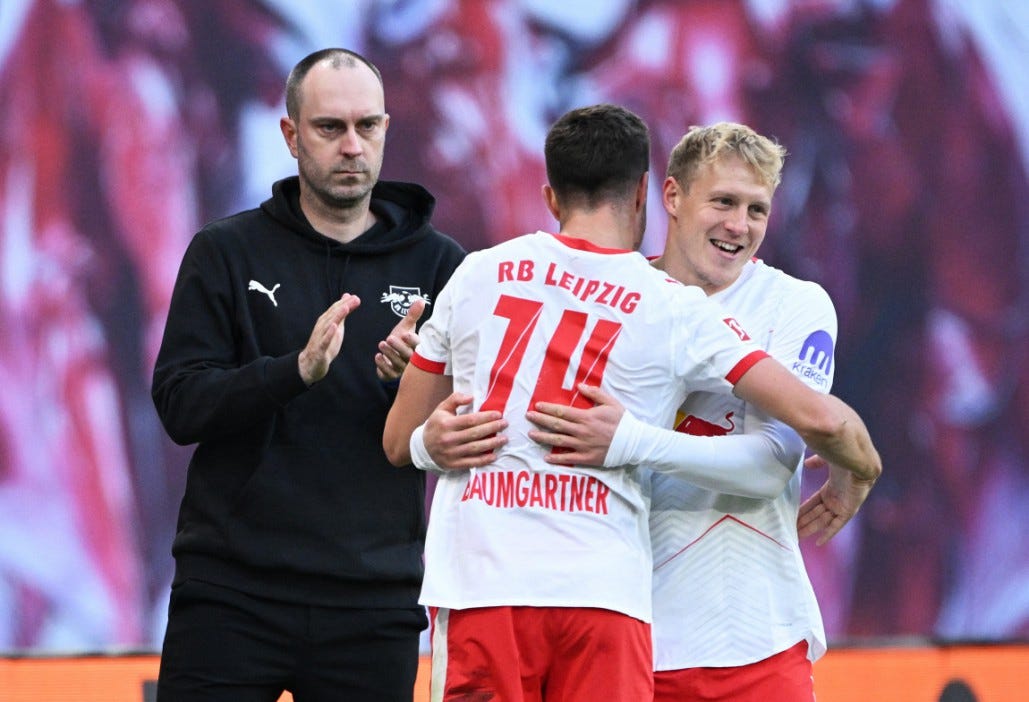
In a club where constant movement has become the norm, Baumgartner, like fellow former Hoffenheim player and now captain David Raum, has settled into his role and embraced his added responsibilities. Premier League interest was well-known in the pair, with former Bundesliga manager Oliver Glasner interested in Baumgartner as a potential replacement for Eberechi Eze. “The club gave me that trust, so in the end, it wasn’t an issue,” said the Austrian upon snubbing transfer interest.
“We are in a period of upheaval and want to see more players shouldering responsibility,” said Werner ahead of the campaign.
Baumgartner’s summer was spent with his recently married wife and in Uganda, where he helped open a school that now has 80 students enrolled and renovated water wells, for which he was awarded the ‘European Fair Play Diploma’.
On the pitch, Baumgartner has helped answer one of the key questions facing Werner ahead of the season: how would the loss of Simons be replaced? Whilst the Dutch playmaker’s ingenuity and ability to freeform in any given offensive situation are unique, there’s been a new shade of unpredictability to how Leipzig attack and defend from the frontline.
It’s telling that the 6-0 drubbing against Bayern, where most of the damage was done before the hour mark, was without Baumgartner on the pitch. The setup in Munich was erratic and individualistic, where Simons and Openda started before departing. Since then, Baumgartner has taken up a starting role in the lineup, joining the front three in the press and maintaining the midfield line out of possession alongside the younger but proficient duo of Assan Ouedraogo (19) and Nicolas Seiwald (24), who both boast a nice amount of senior football for their respective ages.
Against Borussia Dortmund, the only other team against whom Leipzig have not won, Baumgartner had the fewest touches (51) of any outfield player to play 90 minutes, yet his involvement was twofold—marshalling and limiting the effectiveness of the hosts’ double pivot, comprising Felix Nmecha and Marcel Sabitzer. The 1-1 tussle was opened by his close-range finish and should’ve been settled by one of the three game-high shots he had.
The goals are a welcome addition to a selfless game. His two against FC Energie Cottbus in the DFB-Pokal finished off underdog optimism in the first half, and he has already exceeded last season’s tally. The recent goal splurge, seven contributions in his last four, has earned him the nickname #BaumGOATner amongst the club’s social media admin and a nomination for the division’s Player of the Month for October. The likelihood is that one of Bayern’s three superstars in contention will secure it, but Baumgartner on the list, like Raum last month, shows that Leipzig, with the elder statesmen in their squad, is moving in the right direction.
Boszball is as flawed and fun as ever
A season of change was bound to happen for PSV Eindhoven sooner rather than later.
The back-to-back Dutch champions, like most clubs outside the Premier League market, had become victims of a wide squad exodus after winning successive Eredivisie titles for the first time since the mid-2010s. Attacking trio Malik Tillman, Johan Bakayoko and Noa Lang were sold to Bayer Leverkusen, RB Leipzig and Napoli, respectively. Olivier Boscagli and Walter Benítez joined Premier League mid-table punchers Crystal Palace and Brighton & Hove Albion; captain and top goalscorer Luuk de Jong also left on a free transfer in a spectacularly executed move to Porto.
A host of astute deals for players young, at peak age, and older, for an outlay of over €60 million, were recruited to fully signify a change in personnel, but not in system. Peter Bosz doesn’t change the system.
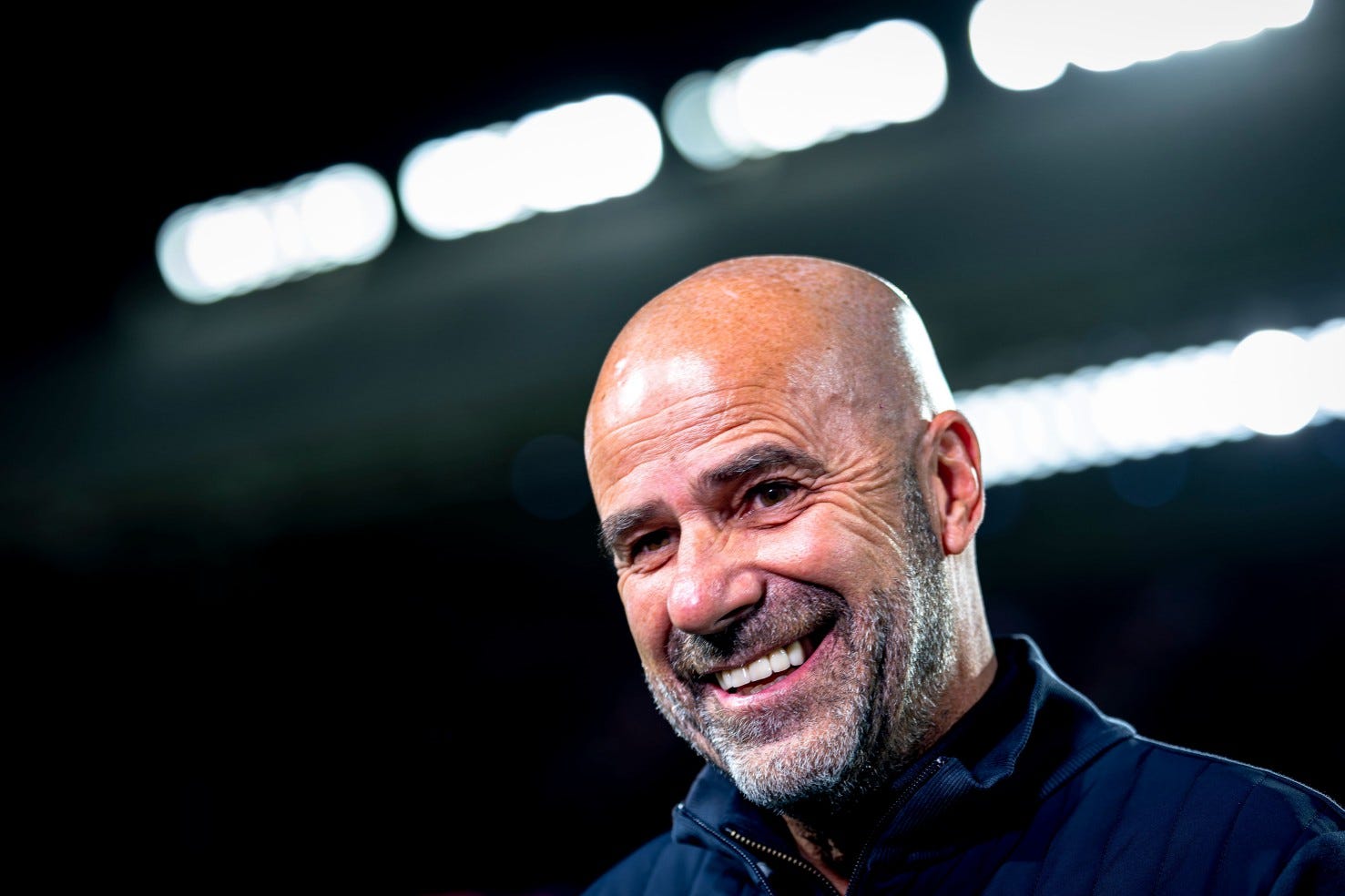
The gruffy Dutch coach, who’s all too aware of what the media thinks and makes Ange Postecoglou’s dogma tendencies look like an Australian tourist, hasn’t steered away from his mantra since his successes with Ajax, where he earned the tag ‘Boszball’ that followed him into his next jobs in Germany, France and now back in the Netherlands. Boszball, a nickname for Bosz’s style of football that wouldn’t look out of place in the new FC26 game, has the goals flowing at both ends, as PSV’s latest ding-dong, in a week and a bit littered with them, showed on Friday night.
Boszball entices not just the crowd but also the opposition. After a first half in which PSV dominated the ball, territory and scoreline (3-0), their visitors, Fortuna Sittard, couldn’t resist having a go in the second half. After all, Bosz’s sides play with such an absurdly aggressive openness that the proposition to also attack is too tempting until the realisation of being webbed by Boszball. It’s been a striking theme in their last few games, including wins against Napoli and title rivals Feyenoord, which saw 13 goals scored.
Despite Bosz suggesting that the source of Fortuna’s brief second-half scare was down to his substitutions, it was his keeper, Matěj Kovář, who cocked up possession before letting the resulting shot trickle under him. It was important not to lose the steady assurance that Boscagli and Benítez brought to the backline. Whilst Leverkusen loanee Kovář has seen his career so far characterised by inconsistencies, his fellow summer acquisition, Yarek Gasiorowski, has excelled in his commanding role at the centre of defence.
Tall, agile, strong in the air, aggressive in duels, and forward-thinking with the ball—all of which come with the added benefit of being left-footed- Gasiorowski’s credentials are of the highest calibre, and one that PSV knew would be profitable in the immediate and, especially, in the future. The 20-year-old Spaniard has been the constant in the backline since arriving from Valencia, where his ball-playing abilities were merely untapped. It speaks to the emphasis Bosz places on possession that defensive midfielder Jerdy Schouten has been converted into a full-time centre-back, playing ahead of highly touted Ryan Flamingo.
Amidst the chaos that can ensue in both halves, Joey Veerman’s profile remains invaluable. The slick, deep-lying playmaker would be playing in the red and white of Brentford, not PSV, if it weren’t for a constant breakdown in club talks. Instead, the sixteen-cap Dutch international still conducts better than anyone in the country from the base of midfield.
Further forward, wingers Ivan Perišić and Dennis Man have been shrewd, below-the-market-value buys, with the latter deputising adeptly for Ruben van Bommel, who had been excelling since his move from AZ Alkmaar before picking up a season-ending knee injury vs Ajax. Perišić, now 36, yet showing renewed flashes of life, alongside Veerman, have created the most big chances in the Eredivisie behind Telstar’s Jeff Hardeveld. In fact, PSV’s chance creation as a team is at an elite level, with only Spain’s Big Two creating more than their 375 shot-creating actions this season, in comparison with Europe’s Big Five. Yet, they have also committed the most errors leading to an opponent’s shot in the league.
The recipient of the constant chance generation is striker Ricardo Pepi, who averages the most shots in the league this season. And the season before that. And the season before that. More of a vertical threat than his predecessor, De Jong, as he showed on Friday night, to practically settle the game. The makeup of the team has platformed Ismael Saibari, an imperfect entertainer himself, which has elevated his performances to MVP-level.
The Moroccan offensive savant’s underlying numbers have suggested an explosion for some time. Now, with a refined finishing, the 24-year-old No.10 is a bona fide match-winner. Saibari’s one-man breakaway-turned-1v1 finish re-took the lead against Napoli before the onslaught happened, his hat-trick at Feyenoord reignited PSV’s presence in the title race and a neatly tucked away header opened the scoring against Fortuna on Friday.
Having players like Saibaris validates Boszball. For a team like PSV, where the current footballing landscape caps its ceiling, the long-term objective leads to the sale of its best players. So maximising the value of a player, particularly attacking players, where their contributions are easier to quantify, actually has a significant benefit on the team before finding the next Saibari. At PSV, Bosz and Boszball have found a place for him to be him, flawed and fun.
Meet the Russian Premier League quartet spearheading the title race thriller
For understandable reasons, the Russian Premier League has fallen short of its peak in the late 2000s and early 2010s, when its leading clubs were prominent and competitive on the global stage.
Now, not in Europe and without its precious financial reward, though recently receiving ‘solidarity’ funds from UEFA, the attraction in Russian football should be at an all-time low. Yet, the league title race and its protagonists are carrying all sorts of appeal.
14 games into the season, there are only five points between the top-five, with the four main contenders all within competitive reach of each other and headlined by league-leading stars.
Last season’s champions, FC Krasnodar, have continued to set the standard this season. Under the ownership of Sergey Galitsky, the club has risen steadily since its promotion in 2010, with its progress culminating in a maiden championship on the final day of last season.
Talisman Eduard Spertsyan has been with the club throughout the project’s inception, attending games in his Krasnodar club merchandise as a twelve-year-old, before joining the academy system and then the first team, where the attacking midfielder of Armenian descent takes full control of Krasnodar’s creative arsenal. The 25-year-old, a proper No.10 throwback, leads the league in most creative metrics, including assists – his ten is more than double the next best – and also boasts a wicked set-piece execution.
He [Spertsyan] is the captain of a championship club; he grew up here and wanted to stay to win more titles. No one pressured anyone; the conversation was very polite, everyone expressed their opinion, and he himself decided what to do,” said Krasnodar manager Murad Musayev to national outlet RB Sports on Spertsyan’s decision not to pursue transfer interest from England in the summer. Head coach of the league’s surprise package, Baltika, Andrei Talalaev was quick to express his admiration for Spertsyan, saying he would take him over Cristiano Ronaldo.
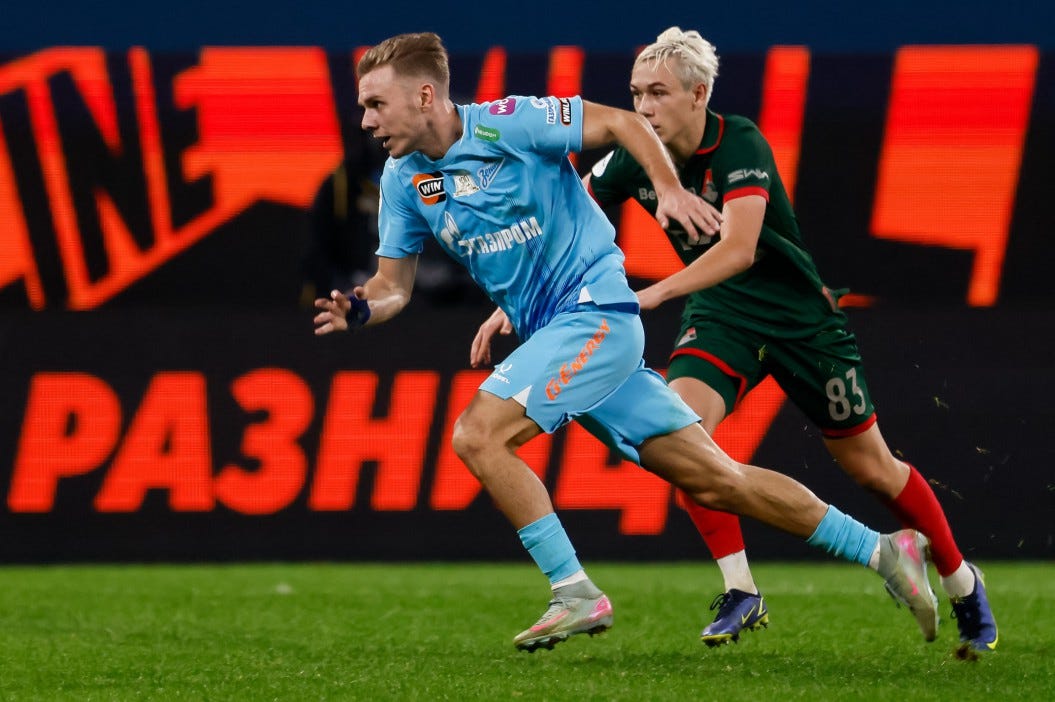
Spertsyan’s Krasnodar pipped Zenit Saint Petersburg, whose recent six-in-a-row title run has been characterised by a Brazilian churn. However, it’s domestic talent Maksim Glushenkov, who has blossomed into his chief role since leaving Lokomotiv Moscow.
Like the aforementioned Krasnodar star, Glushenkov’s side gears most attacks through him. Operating on the right, once Zenit attacks develop into a more substantial state, Glushenkov sparks into play with his livewire left foot that is capable of providing and producing damage. Glushenkov, 26, has sought a role in a team that maximises his dynamo skillset. Six teams in six years before landing in Saint Petersburg with Sergei Semak.
No one in the league with at least seven starts averages more than Glushenkov’s 1.9 shots on target per game. He was also the latest recipient of the Player of the Month and Goal of the Month awards, which are voted on by fans, experts, and commentators. On Saturday, against his former club Lokomotiv, he was the decisive threat throughout the first half, assisting the opener and causing offensive mayhem in the 2-0 win.
Zenit’s historic rivals, CSKA Moscow, sandwich them in second place, with Krasnodar in third. Although not led by a maverick figure, the team philosophy instilled by Fabio Celestini has created an opportunity for a young player to reinvent the perception of his position in the country.
Despite being regarded as a defensive midfielder, Matvey Kislyak possesses remarkable grace and adaptability. CSKA’s philosophy, which emphasises ball control and systematic chance generation, offers Kislyak the perfect environment in which to develop. It does more than just perform the duties of a basic packer or an attack disruptor. Starting with supporting the centre defenders and continuing with surges into an opponent’s penalty area, Matvey actively gets involved in creating attacks – a role not atypical for a Russian defensive midfielder – leading CSKA in goal contributions (8) and tackles per ninety (2).
The 20-year-old’s demand for more responsibility is expanding. Midfield panther Ivan Oblyakov still holds the most authority in the team’s general play, but in CSKA’s recent outing, a 2-0 win over Nizhny Novgorod, various of Kislyak’s game-high 104 touches and 21 passes into the final third created the match’s best chances, including the opening penalty and a well-timed run and header finish for the second.
In a recent one-on-one interview with journalist Nobel Arustamyan, Kislyak stated his ambition of being recognised for the game’s most prestigious award: “I want to be nominated for the Ballon d’Or. Some might say, ‘He’s talking nonsense.’ But I have those goals, those dreams.” His talents, which have only been on display for two years at the senior level, have led to an inevitable call-up to the national team earlier in the year and clearly caught the eyes of Champions League teams already, with Turkish giants Fenerbahçe and Galatasaray both registering public interest in a deal.
No one commands transfer interest, or attention in general, quite like Aleksey Batrakov. He’s widely regarded as the best thing coming out of the country. At 5ft7 and 20 years of age, the Lokomotiv ace already has the enviable trait of making grown men look quite silly, whether that be his 30-yard piledriver opener against CSKA or the pieces of sheer flair for the national team.
Mikhail Galaktionov’s Lokomotiv style is a fantastic fit for Batrakov’s qualities. The team uses quick, nearly instant attacks. The precocious attacker is a shifty, nimble leadman in their forward line and serves as the thread that connects the team’s many lines in this tactic. Last season, he led the entire European teenage cohort for chances created. Yes, over Ballon d’Or runner-up Lamine Yamal and Champions League winner Désiré Doué. This season, he leads the Russian top flight in goals with 10 goals so far.
According to a reputable CIES report, only the Primeira Liga duo of Rodrigo Mora and Georgiy Sudakov are more valuable midfield assets outside of Europe’s top five leagues. Manchester City, Barçelona, Paris Saint-Germain and Olympique de Marseille have been names touted for his potential future. The extent to which it remains a possible destination, given the current political landscape, remains unclear. However, what is clear is that, through a leading domestic cohort, the Russian Premier League has the appeal it has been lacking.
Other happenings
Olympique Lyonnais signed Hans Hateboer in a ‘joker’ deal from Stade Rennais that helped the French club alleviate depth concerns and provided the Dutch defender with more guaranteed playing time. However, a mistimed tackle on his full debut, which resulted in a seventh-minute sending-off – the quickest in Lyon’s Ligue 1 history – will now see Hateboer miss at least one, possibly more, game. Hateboer played seven years for Gian Piero Gasperini’s Atalanta in its most demanding position at wing-back. It’s showing.
The Allsvenskan has offered storylines unlike many others this season. Mjallby AIF, the club from a small Swedish fishing village, won their first-ever title a couple of weeks ago. Now, GAIS were also minnows until the last few years; they catapulted themselves out of the third division in 2022 and are now set to play in a proper European competition next season, their first qualification since 1990.
The Premier League and its Boxing Day fixture was a long-debated topic this week amongst football fans with a semi-interest. After all, once the Big Day is done, it’s the highlight of many people’s holiday, whether going to games or watching them from home. Manchester United will host Newcastle United in the top flight’s standalone fixture, the fewest since 1982, when there were none. Anyway, at least that Labubu set won’t go to waste?
Hat-trick Hour
The release of the new Football Manager 26 is always a poignant reminder of the wonderkids of yesteryear.
After a two-year wait, some FMers, including myself, would’ve probably been stunned to find out that some of the early-20-somethings who had been running back their treble treble seasons with in FM24 aren’t as good now. Or reminiscing about those that the game rated so highly.
Take Mariano Díaz. The talented bagsman who broke all sorts of youth records upon his rise at Real Madrid Castilla and was touted to break even more records at the senior level, with his ridiculous 17 finishing and 18 off-the-ball, according to the FM developers. Now, at Deportivo Alavés, after a productive spell in France with Lyon that failed to yield opportunities with Real and Sevilla, Díaz may not be on the global star track he was once positioned to be on, but he does still show flashes of the sharp, jet-heeled striker. His hat-trick on Thursday showed that.
The 32-year-old striker, who now represents the Dominican Republic at the international level rather than his native Spain, was active against sixth-division side CD Getxo in the Copa del Rey first round, converting 33.3% of his nine shots and notching an assist. All three finishes showed the burly brute’s anticipation to snuffle out goals, which he was initially known for.
It was a rare, significant outing for Díaz, who last played more than an hour at club level back in November 2023. 6.5 out of 10.